Posts Categorized: Hajj

Loving Madinah over Makkah?

7

I don’t know why but my heart always inclined towards Madinah more so than Makkah. Perhaps it’s because of the serenity and calmness of Madinah as opposed to the congestion of Makkah. It bothered me, “Am I doing something wrong? Isn’t Makkah more virtuous than Madinah?”
Shaykh Salih al-Suhaymi put my heart at rest:

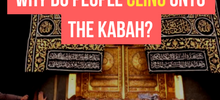
Al-Multazam – Why do people cling onto the Kabah?

5

The multazam (place of clinging) is the area wherein a supplicant rests his chest, forearms including the palms and his face against it, making du’a to Allah. Therein he would praise and glorify Allah, taking refuge with Him, seeking His forgiveness and asking for his needs.
The multazam is the part of the Ka’bah that is between the Black Stone and the door of the Ka’bah according to the most popular opinion.
Some reports indicate that it is the back wall of the Ka’bah whilst other reports indicate that it is under the mizab (drain pipe located at the top of one of the walls of the Ka’bah).
Some scholars viewed that the multazam is every part of the Ka’bah. This view, though not adopted by many, appears to be very probable. This is because if all the narrations supporting the different views are authentic then it indicates that the actions of the sahabah (companions), may Allah be pleased with them, was not to specify a particular place, but it was according to what was easy for them or what was known among them. And Allah knows best.

It should be noted that the authenticity of those narrations tracing back to the Prophet salla Allahu ‘alayhi wa sallam, connecting the multzam to him, are debated over. However, we have authentic narrations attributing the multazam to the companions and the generations that followed them.
There is no specific du’a that should be said at the multazam. The scholars have stated that the Muslim may cling on to the multazam when he enters the Ka’bah, or when performing the Farewell Tawaf, or at any time he wishes.
If one observes the multazam then he should not cause difficulty for other people by offering a lengthy du’a. He is not to annoy or harm the Believers in an attempt to reach the wall.

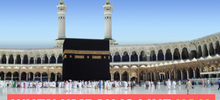
Some questions you never thought to ask about the Ka’bah

4

1. Was it always black?
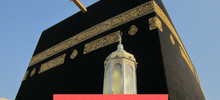
Did you know the Ka’bah was covered in green and white coverings? Throughout our history it was covered in an array of colours. It’s only from the Abbasid period that a black covering in it entirety was adopted.

2. Did it have any windows?
The Ka’bah used to have two doors; one for entering and the other for exiting. It also had a window on one of its sides.
The current Ka’bah only has a single door, and no windows.

3. When is the door to the Ka’bah open?
The Ka’bah used to be open twice a week. People would enter and pray therein. However, it is now opened only two times of the year for dignitaries and guests, and perhaps for the occasional cleaning.
Watch the doors of the Ka’bah being opened:

 
4. What’s inside the Ka’bah?
Okay, this is a common question. It is an empty chamber with a few pillars. The entrance door is called Bab al-Tawbah (Door of Tawbah) because fixed onto it are plaques with verses from Surah Tawbah.
Videos depicting the insides of the Ka’bah:

Note: The hatim is part of the Ka’bah. The hatim is a semi-circular wall opposite, but not physically connected to, the north-west wall of the Ka’bah. It is composed of white marble. At one point in time the space lying between the hatim and the Ka’bah belonged to the Ka’bah itself, and for this reason it is not entered during the tawaf. At least many of us can say we’ve been in the Ka’bah… smile

5. The Black Stone is broken?
The Black Stone is surrounded by a manufactured silver casing because it is broken.
Historians differed as to its cause. However, many agree that it was most damaged in the middle ages by an extreme heretical Ismaili group from Bahrain called the Qarmatians who had declared that the Hajj was an act of superstition. They decided to make their point by killing tens of thousands of hujjaj and dumping their bodies in the well of Zamzam.
As if this act of treachery was not enough, these devils took the Black Stone to the East of Arabia and then Kufa in Iraq where they held it ransom until they were forced to return it by the Abbasid Caliph. When they returned it, it was in pieces and the only way to keep them together was by encasing them in a silver casing. Some historians narrate that there are still some missing pieces of the stone floating around.
Source
Drinking Zamzam is Worship

3

Drinking Zamzam is an ‘ibadah (act of worship). It is a means of seeking closeness to Allah.
The Prophet salla Allahu ‘alayhi wa sallam said, “The water of Zamzam is for whatever it is drunk for.” Reported by Ibn Majah.
Our righteous predecessors would act upon this hadith verbatim:
– Ibn ‘Abbas drank from the water of Zamzam and he said, “O Allah, I ask you for beneficial knowledge, plentiful provision and healing from every disease.”
– Al-Humaydi said, “We were with Sufyan ibn ‘Uyaynah, and he told us the hadith about the water of Zamzam being drunk for whatever purpose it is drunk for. A man got up and left the gathering and then returned and said, ‘O Abu Muhammad, is the hadith which you told us about the water of Zamzam sahih?’ He said, ‘Yes.’ The man said, ‘Just now I drank a bucket of Zamzam so that you would tell me one hundred hadiths.’ Sufyan said, ‘Sit down,’ so he sat down and he told him one hundred hadiths.”
– Ibn al-Qayyim once said, “Myself and others tried seeking healing with Zamzam water and saw wondrous things. I sought healing with it from a number of illnesses, and I was healed by the permission of Allah. I saw someone who nourished himself with it for a number of days, half a month or more, and he did not feel hunger…” [Zad al-Ma’ad]
– The scholars say it is sunnah to drink one’s fill of Zamzam. Abu Dharr once stayed near the Ka’bah and its coverings for forty days and forty nights with no food or drink other than Zamzam. When asked by the Prophet as to how he nourished himself, he answered, “I have had nothing but Zamzam water, and I have gotten so fat that I have folds of fat on my stomach. I do not feel any of the tiredness or weakness of hunger and I have not become thin.” The Prophet said: “Verily, it is blessed, it is food that nourishes.” Other narrations include, “… and a healing for sickness.” Reported by Muslim and others.
What would you intend or make du’a for when drinking Zamzam?

Umrah in Ramadan is like Hajj?

2

The Messenger of Allah (peace and blessings of Allah be upon him) asked a woman, “What kept you from performing Hajj with us?” She replied, “We only have two camels and the father of her son and her son had gone for Hajj on one camel, and he left us the other camel so that we could carry water on it”. He asked, “When Ramadan comes, go for ‘Umrah, for ‘Umrah in (that month) is equivalent (in reward) to Hajj.” Reported by Al-Bukhari and Muslim.
The scholars differed concerning the one who attains the virtue mentioned in the hadith. There are three opinions:
1 – That this hadith applies only to the woman who was addressed by the Prophet (peace and blessings of Allah be upon him).
2 – That this virtue is attained by the one who intends to do Hajj but is unable to do it, then he makes up for it by doing ‘Umrah in Ramadan. For by combining the intention to do Hajj with performance of ‘Umrah in Ramadan, he attains the reward of doing a complete Hajj with the Prophet (peace and blessings of Allah be upon him).
3 – The view of the scholars of the four schools of thought and others, that the virtue mentioned in this hadith is general in meaning and applies to everyone who does ‘umrah in the month of Ramadan. ‘Umrah at that time is equivalent to Hajj for all people, not just for a few people or in certain circumstances.
The most correct of these opinions – and Allah knows best – is the last one, and the virtue is general in meaning and is attained by all those who do ‘umrah in Ramadan.